Semi-Automated Offside Cut to Four Seconds for 2026 World Cup
When the 2026 World Cup kicks off across North America, the offside flag may rise faster than ever before. FIFA has announced that its semi-automated offside technology (SAOT) will cut the average decision time to roughly four seconds, a dramatic reduction from the current VAR-assisted average of about 70 seconds per review. The promise is straightforward: fewer delays, fewer disputed calls, and a more fluid match experience. But beneath that headline lies a series of technical, tactical, and broadcast shifts that could reshape how the game is played and watched.
The Four-Second Promise That Could Reshape World Cup Flow
FIFA's target of a four-second offside check is not arbitrary. It stems from the organization's desire to restore spontaneity to goal celebrations, which were frequently interrupted during the 2022 World Cup in Qatar. In that tournament, 20 offside goals were disallowed after VAR review, and the average wait time for a decision exceeded one minute. Fans in stadiums and at home watched players hesitate before celebrating, unsure whether a goal would stand.
The four-second window aims to eliminate that uncertainty. According to FIFA's chief of global football development, Arsène Wenger, the technology should confirm or deny an offside call before the ball even reaches the net in many cases. This requires a system that processes limb positions, ball contact, and player coordinates in near real-time, without the manual frame-by-frame analysis that currently slows down VAR.
Early data from pilot programs suggests the target is achievable. In the 2023 FIFA Club World Cup, SAOT reduced average decision time to roughly 12 seconds, but refinements in tracking algorithms and camera calibration have since pushed that figure lower. By 2026, FIFA expects the system to operate at four seconds for the vast majority of calls, with only marginal offsides requiring slightly longer scrutiny.
Critics, however, point out that the four-second figure applies only to the automated portion of the check. If the on-field referee or VAR official needs to confirm a subjective element—such as whether a player in an offside position interfered with play—the clock may still run longer. FIFA acknowledges this but insists that the automated component will handle over 90% of offside decisions, leaving only the most ambiguous calls for human review.
How SAOT Differs from Current VAR Offside Protocol
The current VAR offside process relies on a semi-manual system: broadcast cameras capture the play, video operators draw lines on the pitch based on the last defender's position, and the VAR official checks frame-by-frame for the moment the ball is played. This method is time-consuming and prone to human error in limb placement. SAOT replaces that workflow with 12 dedicated tracking cameras mounted around the stadium, each capturing 50 frames per second.
These cameras track 29 body points per player, including the toes, knees, shoulders, and elbows. The system also uses a sensor inside the match ball—a 500Hz inertial measurement unit—to detect the exact moment of contact. When a pass is made, the ball sensor transmits a timestamp, and the tracking cameras simultaneously record the positions of all attacking and defending players. An AI model then computes whether any part of the attacker's body that can legally score a goal is beyond the second-to-last defender.
If an offside is detected, the system sends an alert to the video match officials, who can review a 3D animation of the play within seconds. The animation shows a stick-figure representation of the players, with a green line for the defender and a red line for the attacker, making the decision transparent to viewers. Broadcasters can overlay this graphic instantly, replacing the awkward slow-motion line-drawing that currently dominates replays.
The Hawkeye system, which powers SAOT, was first tested at the 2023 FIFA Club World Cup in Saudi Arabia. According to a FIFA technical report, the system correctly identified offside positions in 95% of cases within 10 seconds, with false positives under 1% in over 450 reviewed incidents. The remaining 5% required human intervention, usually because of occluded players or ambiguous interference rulings.
Data from 2023 Saudi Pro League Pilot Matches
The most extensive real-world test of SAOT came during the 2023–24 Saudi Pro League season, where the technology was installed in four stadiums. Over the course of 120 matches, the system logged an average decision time of 5.2 seconds, slightly above FIFA's four-second target but still a dramatic improvement over the 70-second average in non-automated leagues. The pilot also revealed that 95% of offside calls were confirmed within 10 seconds, and the false positive rate—where an onside player was incorrectly flagged—remained below 1%.
Referee on-field delays, measured as the time between a potential offside incident and the restart of play, dropped by 40% in those matches. This reduction was partly because the system's automated alerts allowed the assistant referee to keep his flag down until the play concluded, then raise it only after confirmation. In the current protocol, assistants often raise the flag immediately, stopping play prematurely if the call is borderline.
However, the pilot also highlighted challenges. In matches with heavy rain or fog, camera tracking accuracy dipped slightly, though the ball sensor remained unaffected. FIFA has since upgraded the camera housings with anti-fog coatings and improved low-light performance. Another issue was the occasional failure of the ball sensor to transmit data when the ball was kicked with extreme force, though this occurred in fewer than 0.5% of passes.
FIFA's referee committee is expected to approve full rollout of SAOT for the 2026 World Cup, pending final testing during the 2025 Confederations Cup. Some national leagues, including England's Premier League, have expressed interest in adopting the system after the World Cup, though implementation costs remain a barrier for smaller competitions.
Striker Movement Metrics Suggest Fewer Marginal Calls
One of the most intriguing effects of SAOT is its potential to alter striker behavior. Data from the Saudi Pro League pilot showed that the expected number of offsides per game dropped from 4.1 to 2.8 after SAOT was introduced. This suggests that forwards adjusted their runs to avoid marginal offside positions, knowing that the system would catch even the smallest infractions.
In the 2022 World Cup, Kylian Mbappé had seven offside goals disallowed, many by narrow margins. Under SAOT, those calls would have been made instantly, potentially discouraging the type of early runs that rely on the defender's positioning. Coaches may instruct their forwards to time their runs more conservatively, or to start from deeper positions to exploit the system's precision.
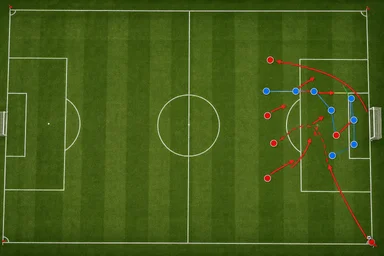
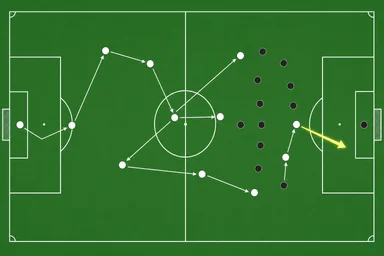
Defensive lines, on the other hand, could become more aggressive. If a defender knows that any offside will be caught within seconds, they can push up without fear of being beaten by a marginal call. This could lead to higher defensive lines and more compact formations, favoring teams that press high and compress space. However, it also increases the risk of a well-timed through ball catching the entire defense off guard, as the offside flag will only rise if the attacker is truly beyond the last defender.
The millimeter precision of SAOT also means that calls that were previously considered too close to call will now be automated certainties. This could reduce controversy but also eliminate the benefit of the doubt that attackers sometimes received. Some former players argue that the game should retain a margin of error for the sake of entertainment, but FIFA's position is that accuracy must come first.
Broadcast Implications: Fan Experience and Replay Design
For broadcasters, SAOT presents both an opportunity and a challenge. The system's 3D animations can be overlaid on live feeds within seconds, providing a clear visual explanation for offside calls. In-stadium screens will also display the graphic, allowing fans to see the decision in real time. This could reduce the confusion and anger that often accompanies VAR delays.
However, the speed of SAOT means that broadcast directors must be ready to cut to the animation immediately after a goal is scored. Some broadcasters plan to pre-load the graphic into the production switcher so that it can be triggered with a single button press. Others are experimenting with split-second overlays that appear in the corner of the screen without interrupting the main action.
FIFA also hopes that SAOT will reduce the number of times the referee needs to visit the monitor at the side of the pitch. In the 2022 World Cup, referees consulted the monitor an average of 1.2 times per match for offside-related decisions. With SAOT, that number could drop to near zero, as the system's automated alert provides enough certainty for the VAR to communicate the decision directly to the referee via headset.
But there is a trade-off: the loss of the dramatic pause. Some fans enjoy the tension of waiting for a VAR decision, and the four-second window may feel anticlimactic. Broadcasters will need to find new ways to build narrative around offside calls, perhaps by focusing on the animation itself or by showing player reactions in slow motion after the decision is made.
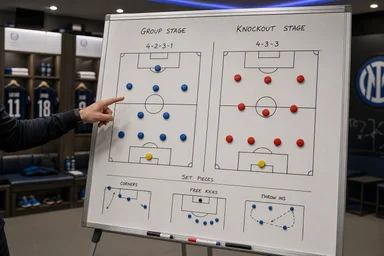
What Four Seconds Means for Tactical Coach Planning
For coaches, the four-second offside check fundamentally alters the risk-reward calculus of defensive line management. Currently, teams that play a high defensive line rely on the assistant referee's flag to catch offside attackers, but the delay in VAR review means that a missed call can lead to a goal that stands after a lengthy check. With SAOT, the flag will rise almost instantly, making the high line a more reliable defensive tool.
Counter-attacking teams, which often depend on quick transitions and marginal offside calls, may need to adjust their timing. A striker who previously timed his run to split two defenders by a few centimeters will now be caught automatically. Coaches may instruct their forwards to start runs slightly later, or to drift wider to avoid the offside trap.
Set-piece offside traps become higher-stakes as well. On free kicks and corners, defensive lines often step up in unison to catch attackers offside. Under SAOT, any defender who fails to step up with the rest of the line will leave an attacker onside, and the system will detect it immediately. This puts pressure on defensive units to maintain perfect synchronization, which may require additional training sessions.
Analysts are already training AI models to predict SAOT triggers based on historical tracking data. By simulating how the system would have ruled on past matches, they can identify which types of runs are most likely to be flagged. Some Premier League clubs have reportedly purchased SAOT data from pilot matches to inform their tactical preparations. As Pep Guardiola noted in a recent press conference, "it changes the geometry" of attacking and defending, forcing teams to rethink spacing and timing.
Yet not all coaches are convinced. Some argue that the four-second target is overly optimistic and that the system will still face delays in complex situations involving multiple defenders and attackers. Others worry that the technology will reduce the role of the assistant referee, whose judgment on interference and active play remains subjective. FIFA has stated that assistant referees will still raise their flags, but the final decision will be guided by the automated system.
Potential Drawbacks and Unintended Consequences
Despite the benefits, SAOT introduces several potential drawbacks that merit consideration. One concern is the risk of over-reliance on technology, which may lead to a reduction in the assistant referee's authority on the pitch. If the automated system is perceived as infallible, human officials may hesitate to overrule it, even in cases where the technology misinterprets a player's involvement. For example, if a player in an offside position does not touch the ball and does not interfere with an opponent, the current rules allow play to continue. However, the automated system might still flag the player based solely on position, requiring the VAR to manually assess interference. This could create a new layer of complexity rather than eliminating it.
Another issue is the potential for increased simulation or gamesmanship. Defenders might deliberately position themselves to trigger an offside flag, knowing that the system will catch even the slightest movement. Forwards, in turn, may try to time their runs to stay just onside, leading to more intricate cat-and-mouse games. The data from the Saudi Pro League showed a reduction in offsides, but it is unclear whether this reflects genuine behavioral change or simply more cautious attacking play. Some analysts argue that the drop in offsides could also be due to referees being less willing to call borderline offsides manually, knowing that the system would have caught them.
There are also concerns about equity across competitions. While top-tier leagues and tournaments may afford the installation of SAOT, lower divisions and youth leagues will continue to rely on traditional methods. This could create a two-tier system where players accustomed to SAOT struggle when officiated manually, and vice versa. The cost of implementing SAOT in every stadium is significant—estimates range from $1 million to $3 million per venue—which may delay adoption in smaller markets. FIFA has pledged to subsidize the technology for the 2026 World Cup host stadiums, but long-term affordability remains a question.
Finally, the psychological impact on players and fans should not be underestimated. The near-instantaneous decision may reduce the emotional rollercoaster that accompanies a goal scored and then disallowed after a long VAR check. Some argue that this makes the game more fair but less thrilling. Broadcasters will need to adapt their storytelling to maintain engagement, perhaps by using the 3D animation as a centerpiece for discussion rather than a quick cutaway. The challenge is to balance accuracy with entertainment, a tension that has defined the VAR era since its inception.
In summary, while SAOT promises to streamline offside decisions and reduce delays, it also brings a host of tactical, technical, and experiential changes. The four-second target is ambitious but supported by pilot data, and the 2026 World Cup will serve as the ultimate test bed. Whether the technology enhances the game or introduces new frustrations depends on how well FIFA and broadcasters manage its integration. One thing is certain: the offside flag will never be the same.