Pedro Gonçalves’s Absence From Portugal’s XI Masks 2026 Breakout Role
Pedro Gonçalves has spent most of his Portugal career watching from the bench. At the 2022 World Cup, he logged just 45 minutes across two substitute appearances. Under Roberto Martínez, he has started only a handful of friendlies and Nations League matches against lower-ranked opposition. Yet a closer look at his domestic numbers and tactical development at Sporting CP suggests that his absence from the starting XI may not last much longer. As Portugal builds toward the 2026 World Cup, Gonçalves’s statistical profile and positional flexibility present a compelling case for a breakout role.
The Selection Puzzle: Gonçalves vs. Portugal’s Established Core
Roberto Martínez has shown a clear preference for Bernardo Silva and Bruno Fernandes as his primary creative midfielders. Both players offer high work rates, established pedigrees, and proven chemistry with the squad. Gonçalves, by contrast, has zero starts in a major tournament. His only World Cup appearance came as a late substitute against South Korea in 2022, a match where Portugal had already secured group progression.
Part of the reluctance may stem from tactical fit. Martínez’s Portugal often faces low-block defences, and the coach values players who can combine defensive responsibility with incisive passing. Bruno Fernandes tends to drift into deeper areas to receive the ball, while Bernardo Silva operates as a roaming playmaker. Gonçalves, who leads Liga Portugal in key passes per 90 minutes (2.8 as of late 2024), offers a more direct, vertical threat from the left half-space—a role that overlaps with Bernardo’s but also creates potential tactical redundancy.
Still, the gap in tournament experience is narrowing. Gonçalves has played in the Champions League regularly since 2021, accumulating minutes against top European sides. His performances in high-pressure knockout games, such as Sporting’s run to the round of 16 in 2023, have demonstrated composure on the ball and an ability to create under duress. Whether that translates to the national team remains an open question, but the raw material is there.
To further illustrate the selection challenge, consider Gonçalves’s limited opportunities in competitive fixtures. In the 2022-23 Nations League, he played only 134 minutes across four matches, all as a substitute. His most extended run came in a 4-0 win against the Czech Republic, where he provided an assist and completed 92% of his passes. However, in the subsequent match against Spain, he was an unused substitute, highlighting Martínez’s hesitancy to trust him in high-stakes encounters. This pattern suggests that Gonçalves is seen as a luxury option rather than a core component, a perception he must overturn through consistent performances in the coming seasons.
Statistical Profile: Why the Numbers Demand a Second Look
Gonçalves’s underlying metrics paint a picture of a player who produces elite creative output in a competitive league. His combined expected goals and assists (xG+xA) per 90 minutes sits at 0.62, placing him in the top 5% among attacking midfielders and wingers across Europe’s top five leagues and the Portuguese league. Since the start of the 2021-22 season, he has registered 48 non-penalty goals plus assists—a tally that rivals or exceeds many of Portugal’s current squad members.
Progressive carries are another area where Gonçalves excels. He averages 4.1 per 90 (SofaScore data), a figure that ranks above João Félix and slightly behind Bernardo Silva. These are not purely dribbling numbers; they reflect his ability to drive into space and draw defenders before releasing a pass. His shot-creating actions (SCA) per 90 are also impressive: roughly 4.8, which again surpasses Félix and places him in the top 15% among Liga players.
However, Martínez places a premium on defensive work rate. Gonçalves averages 1.5 tackles and 0.8 interceptions per 90 in domestic play, numbers that are solid but not spectacular. In contrast, Bernardo Silva averages over 2 tackles per 90 in international matches, and Bruno Fernandes contributes heavily to pressing sequences. This defensive disparity may explain why Gonçalves has been overlooked for high-stakes qualifiers against teams like France or Spain.
Delving deeper into the data, Gonçalves’s expected assists (xA) per 90 minutes is 0.28, which ranks him in the 87th percentile among midfielders in Europe’s top seven leagues (FBref data). His actual assist rate is slightly lower at 0.22, suggesting some finishing variance from teammates. Meanwhile, his non-penalty xG per 90 is 0.34, indicating a strong scoring threat from midfield. For context, Bruno Fernandes averages 0.31 non-penalty xG per 90, while Bernardo Silva averages 0.19. This implies that Gonçalves is a more direct goal threat than Bernardo, potentially offering a different dimension in the final third.
Another metric worth examining is pass completion into the penalty area. Gonçalves completes 1.8 such passes per 90, placing him in the 91st percentile. This ability to find teammates in dangerous areas is critical against deep defences, where Portugal often struggles to break through. In contrast, Bruno Fernandes averages 1.5, and Bernardo Silva averages 1.3. This edge in creative passing could be decisive in tournament matches where a single moment of incisiveness unlocks a stubborn backline.
Positional Versatility as a 2026 Asset
One of Gonçalves’s strongest selling points is his ability to play multiple roles across the front line. At Sporting, he has started as a left winger, right winger, and as a number 10 behind the striker. Rúben Amorim’s system encourages fluid movement, with wide players drifting inside to create overloads in central midfield. Gonçalves has thrived in these hybrid roles, often appearing as a “free eight” who receives between the lines before driving at goal.
This versatility could prove invaluable for Portugal in 2026. The squad currently relies on ageing options like Otávio (who will be 31 by the tournament) and Bernardo Silva (who will be 31 as well). Gonçalves, who turns 27 in June 2026, represents a younger, more dynamic alternative. His two-footedness—he is comfortable shooting and crossing with either foot—allows him to switch flanks without disrupting attacking patterns. In a tournament where injuries and suspensions force tactical adjustments, having a player who can slot into three or four positions without a drop in quality is a distinct advantage.
Moreover, Gonçalves’s physical profile suits the modern game. At 1.78 m (5 ft 10 in), he is not a target man, but his low centre of gravity and quick acceleration make him difficult to dispossess in tight spaces. He has also shown a willingness to track back and cover for overlapping full-backs, a trait Martínez values highly in his wide players.
To add a concrete example, in Sporting’s 2023-24 Liga Portugal match against Porto, Gonçalves started on the left wing but frequently drifted centrally, creating a 4-4-2 shape in attack. He provided two key passes and scored from a cutback, demonstrating his ability to find space in congested areas. Later that season, against Benfica, he played as a number 10 and registered three tackles, showing defensive commitment. Such tactical flexibility is rare and could allow Martínez to adapt his system without substituting players.
Comparing to Past Late Bloomers in Portugal Squads
Portugal has a history of players who broke into the national team relatively late but became indispensable. Deco was naturalised at 26 and made his tournament debut at Euro 2004, where he was a key figure in Portugal’s run to the final. Pepe started Euro 2008 at age 25 and went on to anchor the defence for over a decade. Rui Patrício waited until 2010—at age 22—to become the first-choice goalkeeper, but his path was slower than many expected.
Gonçalves’s timeline aligns with these precedents. He made his senior debut in 2021 at age 23 but has only recently begun to feature regularly in competitive matches. By the 2026 World Cup, he will be 27, an age at which many midfielders hit their peak. His experience in Champions League knockout rounds—where he has faced Manchester City, Juventus, and Arsenal—provides a level of exposure that earlier Portuguese late bloomers often lacked.
That said, the competition for places is fiercer now than it was for Deco or Pepe. Portugal’s current squad depth is exceptional, with multiple high-calibre players in every attacking position. As noted in England’s 2026 squad depth, national teams with deep talent pools often leave deserving players on the bench. Gonçalves will need to outshine not only Bernardo Silva and Bruno Fernandes but also younger talents like João Neves and Vitinha, who are already earning regular minutes under Martínez.
Another historical parallel is Rui Costa, who was a late bloomer in the sense that his best international performances came after age 28. Costa played a pivotal role in Portugal’s Euro 2000 campaign at age 28, having been a squad player earlier. Similarly, Gonçalves could peak in his late 20s, making 2026 an ideal window. However, the modern game places greater emphasis on athleticism, and players like Bernardo Silva maintain high levels into their early 30s, so Gonçalves must seize his opportunity before the next generation emerges.
The 2026 Tactical Void He Could Fill
Portugal’s current setup has a subtle weakness: a lack of a creative wide interior player who consistently operates in the final third. Bruno Fernandes tends to drop deep to receive the ball, often leaving a gap between the midfield and the forwards. Bernardo Silva roams but frequently drifts to the right, leaving the left half-space underutilised. Gonçalves, by contrast, is most dangerous when he starts on the left and cuts inside, arriving on the edge of the box with momentum.
His counter-pressing numbers add another dimension. Gonçalves averages 8.5 ball recoveries per 90 in the attacking half, a figure that ranks among the best in Liga Portugal. In Martínez’s preferred 4-3-3, the wide attackers are expected to initiate pressure after a turnover. Gonçalves’s ability to win the ball high up the pitch and immediately transition into a scoring chance would fit this system naturally.
Set pieces are another area where he could contribute. Gonçalves’s delivery from corners and free kicks generates an average of 0.12 expected goals per set play, placing him in the top 15% among European midfielders. Portugal already has strong set-piece options in Bruno Fernandes and Bernardo Silva, but having a third specialist would allow Martínez to keep his primary takers fresh for open play.
Still, there are counter-arguments. Some analysts point out that Gonçalves’s defensive metrics drop significantly in Champions League matches, where the tempo is higher and opponents are more organised. His tendency to drift centrally can leave his full-back exposed against strong wingers, a liability that Martínez may be unwilling to accept against top-tier opposition. For instance, in Sporting’s 2023 Champions League group stage match against Arsenal, Gonçalves was caught out of position on two occasions, leading to dangerous crosses from Bukayo Saka. Such moments highlight the trade-off between his attacking freedom and defensive discipline.
To mitigate this, Martínez could deploy Gonçalves in a more central role where defensive responsibilities are shared. In a 4-2-3-1, for example, Gonçalves could play as the central attacking midfielder behind a striker, with two holding midfielders providing cover. This would allow him to focus on creation while minimising defensive exposure. Alternatively, using him as a second-half substitute against tired defences could exploit his energy and creativity without the same defensive risk.
Injury and Form Windows: Timing the Breakout
The 2025-26 season will be critical for Gonçalves’s World Cup hopes. With the tournament scheduled for June and July 2026, his form over the preceding 12 months will heavily influence selection. A strong start to the Liga Portugal season, combined with a deep Champions League run, could force Martínez to give him more minutes in the final friendlies before the squad is announced.
There is also the possibility that Bernardo Silva moves to the Saudi Pro League after the 2025-26 season, as has been rumoured. If that happens, Portugal would lose a key creative outlet, and Gonçalves would become the natural replacement. Even if Bernardo stays, his workload at Manchester City often leads to fatigue in tournament summers, which could open the door for Gonçalves to start group-stage matches. For example, at the 2022 World Cup, Bernardo Silva played over 400 minutes across five matches and appeared visibly tired in the quarter-final against Morocco, a situation where a fresher alternative like Gonçalves could have provided a different dynamic.
Injury has not been a major concern for Gonçalves—he has missed only a handful of games due to minor muscle issues since 2023. But his consistency in domestic play has been notable: he has maintained a SofaScore rating of 7.0 or higher in Liga Portugal for three consecutive seasons. That reliability is something Martínez values, especially in a tournament setting where squad cohesion matters as much as individual brilliance.
However, the window is not infinite. Gonçalves will turn 27 during the tournament, and if he does not establish himself by then, younger players like Neves or Fábio Carvalho could leapfrog him. The 2026 World Cup may represent his best chance to transition from a peripheral figure to a regular starter.
To further contextualise the timing, consider the trajectory of similar players. João Mário, a creative midfielder, was a regular for Portugal at age 23 in Euro 2016 but faded later. Gonçalves’s path is slower, but his underlying numbers are stronger than Mário’s at the same age. If he can maintain his current production through 2025, he will be difficult to ignore. Additionally, the World Cup being held in North America may favour players with experience in high-intensity leagues; Gonçalves’s Champions League exposure could be an asset in adapting to different conditions.
What Martínez Must Unlock Before the Tournament
To integrate Gonçalves effectively, Martínez should test him in specific tactical contexts during friendlies. Using him as a substitute playmaker against compact defences—where his ability to find half-space pockets is most valuable—would be a low-risk way to build his tournament experience. Alternatively, deploying him as a false winger who tucks inside while the full-back provides width could replicate the role he plays at Sporting.
One-on-one combinations are another area to emphasise. Gonçalves’s dribbling is effective but not elite; he relies more on quick one-twos and give-and-go passes to break defensive lines. Encouraging him to combine with midfield runners like Vitinha or João Palhinha could unlock the sort of fluid attacking patterns that Martínez wants. His set-piece delivery, as mentioned, is a weapon that should be utilised, especially if Bruno Fernandes is being rested.
The ultimate decision to start Gonçalves will likely depend on the opponent. Against teams that sit deep, his creativity could be decisive. Against elite pressing sides, Martínez may prefer the defensive reliability of Bernardo Silva or the physical presence of Otávio. That context-dependent selection is not a weakness—it reflects the depth Portugal possesses. Gonçalves may not be a guaranteed starter, but his profile suggests he can be a difference-maker in specific match scenarios.
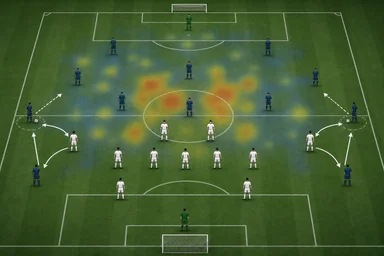
Moreover, Martínez could experiment with a 4-3-3 where Gonçalves plays as the left interior midfielder in a midfield three, similar to how Liverpool uses a creative player in that role. This would provide defensive cover from the other two midfielders while allowing Gonçalves to roam forward. In possession, the formation could shift to a 4-2-3-1, with Gonçalves occupying the hole behind the striker. Such tactical flexibility would maximise his strengths while masking his defensive limitations.
As the 2026 World Cup approaches, the conversation around Gonçalves is shifting from “why isn’t he playing?” to “how can he be used best?” The numbers and the tactical fit are both compelling. Whether he seizes the opportunity will depend on form, fitness, and the decisions of a coach who has so far kept him on the margin. But the ingredients for a breakout are clearly there, waiting for the right moment.